‘Podcasting has become this explosive medium’

Sunday, May 31, 2026
… in which acclaimed broadcaster and podcast host John St. Augustine and I discuss the intersection of news, podcasting … and farmers’ market music.

Thanks, John, for the kind words about my modest efforts in all three arenas.
(Interview recorded March 29, 2026; published May 30, 2026.)

If you like this, check out more of my podcast guidance on Rivet’s website and elsewhere on this blog.

And hear more of my conversations with thought-leaders through the years on
this website, in Apple Music, on Pandora or Spotify, via your favorite podcast player and at Chicago Public Square.

Want to podcast? Create a gripping open.

Sunday, January 14, 2024
(Adapted from my “Four Keys to Creating a Great Audio Interview” for the Orbit Media Studios blog.)

No one gets to the end—or even the middle—of your podcast without listening to the beginning. And a long, wordy, boring open is one of the best ways to ensure people don’t stick around for long.

One key to engaging listeners—especially people new to your podcast (and who doesn’t want a steady flow of them, huh?)—is to open your show with some of the most interesting words from what’s to come.

Here’s a great way to craft a compelling intro for a typical podcast interview:

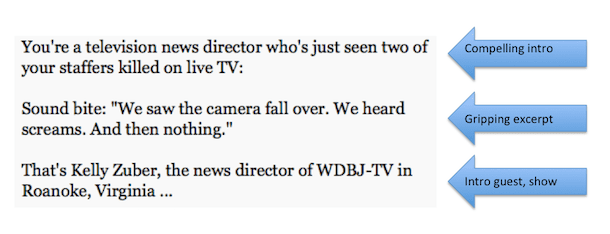
1. A one- or two-sentence preview, beginning with the most compelling words you can muster, leading into …
2. A short (20-30-second) excerpt from your guest or guests—the most exciting, emotionally powerful cut in the whole show.
3. An ID for the guest(s), yourself, your show and your underwriter or sponsor—mixed, if you must, with theme music (which, based on Rivet360’s groundbreaking data, often will prove a tuneout; keep it short if you use it at all).

Here’s a sample (click to hear audio):image02

Here are more examples:


Tip: You can save yourself and your team production work by crafting your “live” intro (the one you read while you’re sitting with your subject), to include a brief pause where you can later insert a cut. The key is to write an intro that alludes to a question you’re sure you’ll be asking. If a stronger cut emerges, you can recut your first few opening words to match that clip and let the rest of your original recording flow from there.


Tip: Spare your listeners the waste of time that is “Thank you for joining us” or “Thanks for being here” at the opening. That just brings things to a halt. (Because we all know what comes next: “Great to be here.” Or “Thanks for having me.” And then a brief, awkward pause.) Thank your guests as profusely as you like—before and after your recorded segment. If you must thank guests—it is hard to resist—don’t wait for an answer; just move directly to your first question. Keep it moving, start to finish. 

How best to open a podcast

Monday, June 12, 2023
I haven’t posted much here lately about my work with the talented team I helped assemble a decade ago at Rivet (now formally known as Rivet360)—mostly in secret at the beginning.

That’s partly because, as I’ve shifted focus since 2017 to my award-winning Chicago Public Square email news briefing (subscribe free!), I’ve eased into a role as Rivet’s Vice President of Editorial and Development—or, as I call myself, Nagger-in-Chief.

And it’s partly because the company’s shifted its focus from journalism to become an innovative podcast consultancy—producing audio for others as well as shows of its own.

One of those shows,
PodWell—a guide to becoming better podcasters—is hosted by my friend and colleague Terri Lydon, who was kind enough to share the mic with me in her June 6 edition (recorded May 3, 2023, when I was just getting over a cold or something else that really wasn’t COVID-19).

That gave me nine minutes or so to nag on one of my favorite topics:
How best to open a podcast.

If you like this, check out more of my podcast guidance on Rivet’s website and elsewhere on this blog.

And hear more of my conversations with thought-leaders through the years on
this website, in Apple Music, on Pandora or Spotify, via your favorite podcast player and at Chicago Public Square.

(Meyerson headshot: Steve Ewert.)

Tips for podcasters

Wednesday, June 12, 2019
Snappy answers to frequently asked questions:

What makes a great podcast?

Your answer’s as good as mine. Probably better. Depends on the interview’s goal. If you’re a funny TV host, and your goal is at least partly to entertain, it’s great interplay between the guest and the host, with lots of laughs or emotion along the way. But most of us aren’t Stephen Colbert; our goal is to connect our audience seamlessly with our guest and his or her insight. To that end, the less of us and the more of the guest and the guest’s wisdom the better. Some of the best interviews I’ve done have been those in which I just ask a little question and let the guests run with it. I get the first words (the words that explain why the guest is interesting or important) and the last words (to say whatever I want); I don’t feel compelled to be anything more than just a low-profile instigator along the way.


What’s the best way to structure an interview?

Depends on your intent: Do you want a full interview segment, or just soundbites? (I recommend going for the full interview, so you have that option even if you just wind up using soundbites.) Ideally, you script a strong intro and a strong close and insert well-scripted questions in between. Here’s a piece I wrote with four tips for creating a great audio interview. Here’s slightly more basic advice, created mainly for students.


How important is it that I not interrupt someone?
Very important. Makes editing harder. If you’re interviewing someone in person or on Skype, you can prep them in advance to watch for your hand gestures, like the raised finger to indicate you’d like to interrupt; or the “wind it up” motion to indicate you have all you need and it’s almost time to close or move on to the next subject. If you have a sense of how much you need from your guest, or how longwinded she or he is, you can coach them beforehand with guidance like “Hey, we have a lot to cover in a little time. Do me a favor and think in terms of (2-, 3-, 4-, whatever)-sentence answers, OK? If I need more on a subject, I’ll ask a followup question.”


What kind of questions should I avoid?

Yes-or-no questions. And plain statements that aren’t questions. (See my interview tips above.)

I can only interview someone by phone. How do I get great sound?

Each of you can record your voices using a smartphone as you talk over a landline. (Clap a few times at a recording’s start to create marks for syncing.) Then your guest can email or otherwise share with you the audio he or she has recorded at that end for melding with your voice. Key to doing this right: Make sure the phone is about 5-6 inches from the speaker’s mouth, preferably pointed at the corner of the mouth so as to avoid popping Ps and blowing Bs. Note: Some phones (early iPhones, among others; newer ones are more flexible) aren’t able to send long recordings. If you’re not sure, you’ll want to test or record in short increments (8-10 minutes) and so each segment’s not too big. Or give each user software that has no limits. (I use Twisted Wave.) Failing this—for instance, if timeliness is more essential than quality—you can use Google Voice, which records both ends of the conversation at phone-quality.

I’m interviewing someone by Skype. What should I do?

Use the best microphone available, ideally a nice USB mic attached to the computer. These don’t have to be expensive; the Blue Snowball, for instance, can be had for under $50 and it works fine. Failing that, an iPhone or other smartphone headset can be better than a computer’s onboard mic. But the onboard mic on most desktop and laptop computers can work reasonably well, too. The key is figuring out where the mic is located on a computer and getting yourself and your guest to sit as close to your computers’ mics as possible. It’s not always intuitive; the mic on some computers is in back of the screen, for instance. On some MacBooks, it’s along the edge—a couple of pinholes next to the headphone jack.

How do I get the best sound when I’m not recording in a studio?

Regardless of the tech you use to record, minimizing echoes is the biggest key to a professional sound. (Clap and listen carefully and you’ll get a sense of how much echo a space has. It’s often a lot more than we realize in everyday life.) For someone using a smartphone to record, simply draping a coat over one’s head can (look stupid, yes; but also) improve the professional sound of the recording tremendously, eliminating the sound of one’s voice bouncing off a nearby wall, mirror or computer screen. Another option: Unmake the bed and get under some pillows or a blanket. Or make a fort out of couch cushions.

How can I make the interview more conversational and casual to get good information?

If you're aiming for a talk-show vibe, you can achieve a lot by constructing and ordering your questions thoughtfully. As I explain here, it’s not an easy thing to write a script (or questions) so that, when read, they don’t sound like they were written and they don’t sound like they’re being read. Note: This isn't so important when you're in the hunt mainly for soundbites or quotes; in that case, your goal is to get your listeners useful, actionable information as frictionlessly as possible. They’re not listening for small talk. Either way, reduce the noise: The “uh-huhs” and the statements that repeat or foreshadow exactly the things your guests have said or will say.

Bonus tips:

  • Avoid the urge to make statements, like, “So, that works pretty well for you, then.”
  • Avoid the old reporter’s trick of seeming to agree with your interviewee to get him or her to keep talking. This is fine if you’re just taking notes, but it makes lame (momentum-killing) listening and difficult editing if you punctuate interviewees’ answers with things like “Huh” or “That’s great” or “Yeah.”
  • Bite your tongue. Your job is to be a question-asking machine. Ask questions and then get out of the way. The easiest way to do that is to write out your questions in advance. You can always ad-lib, but do so knowingly. If you have nothing substantial to say or add, just move on efficiently to the next question.

More questions? Need hands-on help?
Drop me an email.

[Adapted from advice to a Meyerson Strategy client; originally published January 15, 2017, and updated in 2019.]

Podcasting do’s and don’ts

Saturday, April 7, 2018
If you don’t know the work of the multitalented Dometi Pongo, you should. He’s a radio journalist, a podcaster and a newspaper reporter—not to mention a spoken word artist.

How would you caption this photo of Dometi and me by Cody Bahn?
So it was a privilege to team up with him at the Society of Professional Journalists Region 5 Conference in Chicago, April 7, 2018, to share what we’ve learned about audio production and podcasting.

Among the stuff we covered:

• Podcasting basics.
• Equipment do’s.
• Editing do’s and don’ts.
• Interviewing do’s and don’ts.
• Recording do’s and don’ts.
• Scripting do’s and don’ts.
• How to publish.

The PowerPoint presentation embedded below won’t capture all the fun we had—especially since it’s been converted from the original Apple Keynote to a less-excitingly animated PowerPoint file for sharing here. But if you’re just entering the podcast biz, or if you’re already into it and hoping to get better, this will be of some help.


Turning a live event into a podcast: A case study

Sunday, September 10, 2017
Last week, I interviewed my former neighbor, Obama chief strategist David Axelrod, on stage. A sellout crowd of 1,000 people paid to see it, and many more told me they wished they’d been there. So I made arrangements to turn it into a podcast.

Photo: Alexa Rogals, Wednesday Journal
Our hosts at Dominican University, which recorded the event, shared the audio with me. In broad outline, here’s what happened next:
  1. I opened the audio in the free Audacity audio-editing software.
  2. I edited the audio lightly. The mics were too loud in a few instances, and they dropped out in a few other instances. Fortunately, I recorded the whole thing on an iPhone inconspicuously set on the small table between David and me, so I was able to patch the troubled spots with almost-as-good audio. (Can you hear the patches?)
  3. Once the edits were complete, I ran the whole file through Audacity’s Compressor function—raising the soft passages and lowering the loud spots.
  4. I wrote an intro and a close, and recorded them on an iPhone—being careful to isolate my voice by putting a blanket over my head.
  5. I edited those onto the event audio.
  6. I uploaded the completed audio to the free Archive.org website, whose goal is to “provide universal access to all knowledge.”
  7. I embedded the Archive.org audio player on ChicagoPublicSquare.com. (The player’s also embedded at the bottom of this page.)
  8. Then I shared the link widely on Facebook, Twitter and LinkedIn.
Do you have an event whose audio would make great listening? Let’s talk.

So you want to be a podcaster. How will you get people to listen?

Saturday, April 23, 2016
On March 29 [2016], I was invited to address graduate students with Northwestern University’s RSG program (devoted to turning “great researchers into great communicators”) on the subject of podcasting.

We billed it as: “So you want to be a podcaster: How will you get people to listen?”


Mostly for self-critiquing, I recorded the lecture on an iPhone placed in my shirt pocket.


As I listened back afterward, I was pleased enough with the audio quality to clean it up a bit — re-editing in some of the demonstration audio and increasing the volume of audience questions to make them more intelligible. (You’ll hear a little shirt-rustling, but not much more than you’d get with a standard lavalier mic.)


So, for your listening enjoyment, here it is. 


If you’d like to play along, you’ll find the presentation slides here on SlideShare, and embedded below.


So you want to be a podcaster

Thursday, March 3, 2016
[Reposting here a piece prepared for the Chicago Journalists Association website.]

---

Editor's note: Award-winning Chicago radio (WXRT, WGN, WBEZ) and Internet (chicagotribune.com, Rivet) newsman Charlie Meyerson's taking his expertise in audience engagement and radio production on the road over the next few weeks. He'll be leading the "Understand Podcasts" workshop March 23 for the Public Narrative program at Columbia College and delivering a lunchtime keynote address on the same topic March 29 at The Graduate School of Northwestern University in Evanston. With podcasting now an emerging priority for so many media organizations, CJA asked Charlie to share a few pointers for those considering a dive into that pool.

By Charlie Meyerson,
VP/Editorial, Rivet Radio

Fight for your audience's attention. In the digital world, the competition -- whether for text, video or audio -- is just a click away. Don't take a listener's attention for granted. That begins with a great headline or title for your podcast -- and not "My Podcast, Episode 4" -- and it continues with a strong open that'll give listeners a reason to stick around. Tips: Don't waste time giving your podcast's name or episode number or sponsorship until after you've given listeners a reason to stay tuned. And don't spend a lot of time saying things like "Hey, we're back" or "Hi, how ya' doin'?"

Keep it simple. One of the most compelling podcast formats is also one of the easiest and most engaging: The interview. Find an interesting guest and then introduce her or him to your targeted listener, as if all three of you were standing around at a party. I've shared more detailed interview tips in a post for the Orbit Media Studios blog.

Planning's essential. Script your open, your questions and your close in advance -- and practice them. Keep your script relaxed and conversational. Aim to write and read the way you talk. As for the questions: Unless you have expertise of your own, keep your statements or opinions to a minimum. Be a question-asking machine, get out of the way as much as possible and make the show about your guest.

You'll find lots more guidance for creating great audio on the Rivet Radio blog.

You can reach Charlie through his website, MeyersonStrategy.com; or on LinkedIn or by email at charlie@meyersonstrategy.com.