Edward R. Murrow 2016 Award-winner: Our glass desk exploded. Yours could, too.

Friday, July 17, 2026

A decade later, I realize that the work that won the team at Rivet a 2016 national Edward R. Murrow Award for audio investigative reporting hasn’t had a place on this website—or in the Meyerson Interviews podcast series.

This oughtta fix that.

Here’s the entry submission:

2016 Edward R. Murrow Awards

Audio Investigative Reporting
Our glass desk exploded. Yours could, too.
Charlie Meyerson, Jonah Meadows, Elizabeth Giadans, Marc Filippino, George Drake Jr.

ABOUT THIS ENTRY: What would you do if, while you were working overnight, a nearby glass desk just … exploded? When it happened to Rivet’s Jonah Meadows and Elizabeth Giadans, we investigated. What we learned surprised us. Because it happens a lot. (Posted to Rivet Nov. 8, 2015.)

ABOUT RIVET RADIO: Rivet Radio provides customizable audio news globally and across platforms. With millions of listeners, Rivet’s cloud is powering consumer, automotive, home, media and business applications. It’s radio reimagined. Rivet was honored last year with the regional and national Radio-Television-Digital News Association Edward R. Murrow Awards for “Best Use of Sound” and a regional Murrow for “Best Online News Organization”; and with the Chicago Headline Club’s Lisagor Awards for “Best Newscast” and “Best Consumer Reporting.” Rivet was named Best Online Startup at the 2013 Lisagors.

Ms. Magazine editor Robin Morgan in 1992: ‘There are no issues that are not women’s issues’

Wednesday, July 8, 2026

I doubt that back in 1972, when I bought the first issue of Ms. Magazine—whose cover featured the iconic declaration “Wonder Woman for President”—I could’ve imagined that a bit more than 20 years later I’d sit down with that magazine’s then-editor-in-chief Robin Morgan to talk about the state of the women’s movement.

At the time, she was promoting her book The Word of a Woman: Feminist Dispatches, 1968-1992.

Few of my archival interviews through the years resonate as much with the current day as this one does—including Morgan’s comments about the downsides of advertiser-compromised news media.

Listening takes me back to a time that was in many ways hopeful—and conjures a parallel universe we never made. And although some of those hopes have yet to materialize, Morgan’s words then suggest we may yet find our way back.

I hope you find this interview, presented here for the first time since its broadcast on WNUA-FM in Chicago on Dec. 13, 1992, as engaging as I do. Hear here.


Shortly after hearing this resurrected recording, Morgan dropped me an email declaring it “a thoughtful, intelligent interview … certainly one of the best interviews I’ve ever done.”

Hear more of my conversations with thought leaders through the years on
this website, in Apple Podcasts, on Spotify or Pandora, via your favorite podcast player and at Chicago Public Square.

Pulitzer winner Tracy Kidder in 1993

Wednesday, June 17, 2026

The death in March 2026 of Pulitzer winner Tracy Kidder—a reporter The Associated Press credits with turning “everything from computer engineering to life in a nursing home into unexpected bestsellers”—sent me diving back into the archives for the time in 1993 that I was fortunate enough to sit down with him to discuss his then-new book, Old Friends, documenting his year spent visiting and observing the proceedings at a nursing home in western Massachusetts.

To hear him now is to celebrate journalism at its best.

Here’s that interview, digitized and newly available for the first time since its broadcast on WNUA-FM in Chicago on Oct. 17, 1993. (Recorded Oct. 15, 1993.)

Hear more of my conversations with thought leaders through the years on this website, in Apple Podcasts, on Spotify or Pandora, via your favorite podcast player and at Chicago Public Square.

‘Podcasting has become this explosive medium’

Sunday, May 31, 2026
… in which acclaimed broadcaster and podcast host John St. Augustine and I discuss the intersection of news, podcasting … and farmers’ market music.

Thanks, John, for the kind words about my modest efforts in all three arenas.
(Interview recorded March 29, 2026; published May 30, 2026.)

If you like this, check out more of my podcast guidance on Rivet’s website and elsewhere on this blog.

And hear more of my conversations with thought-leaders through the years on
this website, in Apple Music, on Pandora or Spotify, via your favorite podcast player and at Chicago Public Square.

Search Meyerson

Friday, May 1, 2026
Find out what’s been going on here. 
Search functionality devised by Google.

Who could resist an invitation to join a podcast called ‘Misfits Among Us’?

Wednesday, April 15, 2026
I certainly couldn’t. So when Joey Marcus said he wanted to talk, I said yes.


Comics letters page flashback: Justice League [of America] 96

Sunday, August 24, 2025
News of the death of esteemed comics letterhack Guy H. Lillian sent me off to the web in search of letters pages to which we’d both contributed.

The Grand Comics Database didn’t turn up one, but it did point me to a series of Justice League of America issues around 1971, when we both were active …

… and where, in issue No. 96, I made a suggestion that CollectedEditions.com moderator Osgood Peabody generously observed in 2012 “turned out to be years ahead of his time in calling for the JLA to drop ‘of America.’”

As I noted then: “Why, their headquarters isn't even in America anymore—but 22,300 miles out in space!” …

… a comment that prompted editor Julius Schwartz (or maybe one of his ghost writers at the time) to observe, “Almost sounds like a case of ‘America! Love it—or leave it!’”

Was my letter overwritten? You bet—but please note that I was 16 at the time.

As I’ve observed in this space before, those comics letters pages were thick with smart, talented young people—many of whom grew up to be acclaimed comics and TV and movie and publishing pros.

And it’s still a thrill, all these years later, to see my name alongside theirs.

Rest in peace, Mr. Lillian.

Charlie Meyerson …

Friday, August 22, 2025
… has delivered award-winning Chicago-area news for a long time—including more than 10 years at the city’s legendary progressive rock station, WXRT-FM 93.1; almost nine years at pioneering “smooth jazz” station WNUA-FM 95.5; almost 13 years at Tribune Co., as senior producer and Daywatch columnist at chicagotribune.com and then as news director at Chicago’s premier news/talk station, WGN-AM 720.

After a year as Chicago bureau chief for the short-lived (but fun) FM News Chicago and New York—covering government, politics, culture and technology—Meyerson became founding head of news at the digital audio startup Rivet, where he led the team to two national Edward R. Murrow Awards; adjunct professor of journalism at Roosevelt University; an occasional contributor to WXRT, WBEZ-FM 91.5 and Crain’s Chicago Business; and principal at Meyerson Strategy, a content strategy, podcasting and media consulting practice.

With his Rivet colleagues, he has been awarded a U.S. patent for delivering a “contextually relevant media content stream based on listener preference.

His latest project, Chicago Public Square, launched in January 2017, is a return to the newscasting biz—this time through an email-delivered news roundup billed as “Chicago’s new front page.”

You can hear some of his most memorable audio work—old and new—here, here and here.

Meyerson, winner of dozens of journalism awards—including a national Edward R. Murrow Award for audio investigative reporting and a national UPI award for investigative reporting—is not picking his nose in the photo above.


Chronology

“It was a privilege to take … questions about … my journalism career and the state of the news biz.”

“I can trace the origin of my broadcasting career back to Aug. 24, 1973.”
“Charlie walked us through the products that are absolutely essential to his business.”
March 2, 2022: Best free daily roundup in your inbox.’ (Chicago Reader)
Square is the culmination of Meyerson’s … career as a journalist.”
Oct. 29, 2020: This newspaper veteran launched his own Chicago-focused newsletter, and it’s thriving.’ (Tech and media journalist Simon Owens)
“Meyerson had the kind of background that was perfect for launching a Chicago-focused newsletter.”

Sept. 20, 2020: ‘There’s not a project he doesn’t create that a year later you don’t find an award with’ (Weigel Broadcasting executive producer Fred Weintraub)

“Any project that Charlie works on or creates, really, is never a project about himself. It’s about the teams that he creates.”

June 26, 2020: Sustaining journalism in a pandemic: ‘We need each other’ (Illinois Press Association)

“What’s yet to be seen is what that right size is for the media landscape at large. Is it going to be the big companies shrinking, or the small companies growing?”
June 9, 2020: Chicago Public Square: Keeping Chicago informed and winning awards along the way.’ (Rad Letters)
“Readers’ attention is not to be taken for granted. Their priority is fundamentally opposed to publishers’ and broadcasters’ priority: We want them to spend all their time with us, and they want to get on with their lives. In email—as in radio news—every word counts.”
May 28, 2020: Chicago Public Square offers daily news briefings (WGN Radio)
“Charlie joined Bob Sirott to talk about … the competitiveness of digital news… and the ‘embarrassment of riches’ when it comes to news.”
March 18, 2020: Charlie’s daily newsletter … a must-read every single day.’ (WGN Radio)
“Meyerson joins Justin to talk about Oak Park, River Forest and Forest Park leaders urging residents to ‘shelter in place’ to slow the spread of COVID-19.”
Jan. 30, 2020: The future of local news media (Newcity)
“A diversity of reliable, responsible and well-funded sources is a good thing—and a big improvement over the days when a handful of organizations, mostly run by white guys, decided what was newsworthy.”
Nov. 19, 2019: How News Outlets Can Make Email Newsletters More Effective.’ (Local News Initiative)
“Certain words and turns of phrase and presentations and headline styles can work to connect people with great journalism.”
Nov. 11, 2019: Meyerson wins best blog in Chicago Reader poll.’ (Illinois College of Media)
“More than 30,000 people voted in more than 300 categories of the poll.”
May 13, 2019: ‘Meyerson … picked up best radio newscast honors for The Chicago Public Square Newscast.’ (Robert Feder)
“The other finalist in the category was WBBM Newsradio. Meyerson also had a hand in the winner for best podcast, Rivet Radio, where the veteran Chicago newsman works part-time as vice president/editorial and development.”
Sept. 18, 2018: Meyerson … moderated a thoughtful and enlightening panel …’ (Robert Feder)
“… on how newspaper editorial boards operate.”
April 4, 2018: ‘Charlie Meyerson, the veteran Chicago journalist and digital news pioneer who keeps finding new ways to do great work …’ (Robert Feder)
“… just launched a Chicago Public Square Newscast series.”
April 1, 2018: ‘Charlie is a pioneer in the e-newsletter headline business.’ (Illinois Entertainer columnist Rick Kaempfer)
Meyerson has been a part of the Chicago media landscape now for four decades.”
Sept. 13, 2017: ‘Charlie Meyerson, our terrific moderator’ (Wednesday Journal)

“Those of you lucky enough to be in the audience … saw the easy rapport between Axelrod and Charlie ….”
July 28, 2017: This veteran Chicago journalist is using an email ‘newscast’ to keep people informed (Poynter)
“In his opinion… what works in newsletters is what’s always worked best in journalism: Be clear and concise, don’t waste people’s time, offer them something of value.”
June 29, 2016: A Murrow award for Rivet Radio (Chicago Reader)
“A sweet honor for an innovative operation that was a gleam in Charlie Meyerson’s eye just two and a half years ago.”
June 21, 2016: Rivet Radio Makes the Best of a Bad Situation (FishbowlNY)
[The national Edward R. Murrow Award-winning report] “is hosted by Charlie Meyerson.”
March 21, 2016: Free from the tyranny of the clock (WGN-AM podcast)
“Meyerson … joins Justin to discuss the evolution of the media landscape, the future of radio and podcasting, digital media, content creation, the ease of editing, what it takes to get people to listen and finding ways to monetize your product.”
March 3, 2016: Rivet Radio’s Charlie Meyerson gives our readers podcast pointers (Chicago Journalists Association)
Award-winning Chicago radio (WXRT, WGN, WBEZ) and Internet (chicagotribune.com, Rivet) newsman Charlie Meyerson’s taking his expertise in audience engagement and radio production on the road over the next few weeks.”

Sept. 19, 2015: ‘Listen to it like you hate me’: Audio editing advice from a radio professional (Excellence in Journalism 2015 convention coverage)

Meyerson … taught me how to be a sharp self-editor, my best-worst critic, and a tactful audio journalist who throws it back to the basics with Strunk and White.”
Dec. 26, 2013:
Chicago startup Rivet News Radio echoes Zite and Pandora for audio news (Poynter)
“Meyerson explained to me the vision for the service: ‘Our mission is to provide one riveting experience after another.’”
Dec. 3, 2013:
A step fast-forward for radio news? (Reader)
“Meyerson … pretty much laid out the idea of Rivet News Radio in a visionary application to the Knight News Challenge.”
Jan. 7, 2013: Kudos to veteran Chicago newsman Charlie Meyerson …(Robert Feder)

“It’s an ideal match for WBEZ and Meyerson, who pioneered the format as senior producer and Daywatch columnist for chicagotribune.com.”
July 18, 2012: Inside the Merlin staff meeting (Radio Ink)
“We are better positioned, with stronger, sharper skills than any of us had a year ago to go on and create something new again, somewhere else.”
June 24, 2012: Charlie Meyerson: Optimistic News Guy (Radiogirl podcast)
“Charlie … talks about his career at WXRT, WNUA, the Tribune Company, and WGN Radio. He also talks about his audio reports, his new teaching gig at Roosevelt University, and shares his optimism about the media.”
June 28, 2011: Merlin Media Quickly Hires Meyerson (Media Confidential)
“Meyerson has quickly landed a new gig.”
June 19, 2011: Charlie Meyerson Says Goodbye To WGN and Tribune (Chicagoland Radio and Media)
“We moved the news team from its home of a quarter-century on the 1st floor of Tribune Tower to the 4th floor, integrating it more tightly with the Chicago Tribune and WGN-TV news teams. We launched aggressive email and text alert services for our listeners. We overhauled and improved WGNradio.com several times. We aired some of Chicago’s smartest radio news reporting and analysis—on technology, the weather, the environment, politics, civic affairs and more. And the WGN Radio News team’s hard work has been recognized with several significant awards this year: The AP/Illinois prizes for Outstanding News Operation and Best Newscast; the Chicago Headline Club Lisagor Award for Best Newscast; and a contributing role in the Illinois Broadcasters Association Silver Dome awards for Station of the Year and Best Station Website.”
July 29, 2009: WGN-AM names Chicago Tribune Daywatch columnist Charlie Meyerson news director (Chicago Tribune)
“His return to broadcasting, announced Wednesday and effective Aug. 6, comes about 11 years after Meyerson left the business and joined the Tribune to help develop its then-nascent digital presence and strategy.”
Aug. 12, 2008: One-stop news . . . from a newspaper? (Reader)
“Daywatch, the Tribune‘s daily news briefing, isn’t sticking to news originated by the Tribune. Charlie Meyerson, who compiles Daywatch each morning and e-mails it to about 60,000 subscribers, has taken to sweetening the package with stories that catch his eye no matter where he finds them–and that includes in the Sun-Times.”
May 14, 2008: The Power of Connections: Media Meets Mission, panel discussion at The Axelson Center for Nonprofit Management (WBEZ)
“You don’t need a broadcast license, you don’t need to own a huge antenna, you don’t need to have a TV studio, you don’t need to suck up to someone who owns giant printing presses, you know, all you need is a computer or a library card that will get you access to a computer, and … you have the potential to connect to an unlimited audience.”
November 2007: Advancing the Story
“None of this should be cause for despair among journalists who fear becoming slaves to public opinion, reporting only what an audience wants instead of what they think it needs. … Journalists who want to sail an audience in a specific direction need not be slaves to the winds of audience preferences. But, like a good sailor, they can navigate more successfully if they perceive which way those winds are blowing.”
Feb. 18, 2007: Chicago Radio Spotlight
“This is the best time in history to become a journalist.”
Aug. 25, 2006: News breaks at chicagotribune.com
[Review of Meyerson presentation at Society of Professional Journalists convention]: “The BEST convention session I’ve attended.”
July/August 2004: Illinois Alumni magazine
“The WPGU reunion, held in Champaign in April in honor of the student-run radio station’s 50 years of existence, lured Chicago radio news veteran Charlie Meyerson ‘77 COM, MS ‘78 COM, back to campus for the first time since 1987.”
March 14, 2002: Online Journalism Review
“Charlie Meyerson, a chicagotribune.com staff reporter who was a news radio veteran before he became an Internet reporter, informally trains colleagues in broadcast basics in the online newsroom. In addition to his text news updating and reporting duties online, including an early-morning, e-mailed update newsletter to [60,000+] subscribers [as of 2006], he gives an 8 a.m. radio broadcast on WGN-AM, a Tribune Company station.”
January/February 2000: American Journalism Review
“Meyerson and his afternoon counterpart, Joyce Garcia, update the information several times a day, taking feeds from the Tribune’s staff of a half-dozen online reporters and occasionally from the paper’s print reporters. Their goal is nothing less than their slogan—‘Instant Chicago.’”
October 1999: The Communicator
“Three years ago, Charlie Meyerson, the news director at WNUA-FM in Chicago, sent a memo to his new bosses at Chancellor Media Corporation, urging them to embrace the Internet.”
April 7, 1999: Editor & Publisher
“Meyerson, a 20-year radio news and newspaper veteran who recently joined the Tribune breaking news operation, says he won’t be surprised to see some of his old radio listeners become readers of his Web content.”
Oct. 11, 1998: The sound of news is fading out on many FM stations (Chicago Tribune)
“Meyerson … [is] taking his time before deciding what his next move will be, and it may not be back to the radio airwaves. He says that whatever happens, the Internet is bound to create more opportunities for journalists who know how to make news compelling: “The one thing that won’t change is the ability to tell a story, and tell it well.”
Sept. 2, 1998: Sam Weller’s 411 (Newcity)
“Longtime WNUA-FM 95.5 news director Charlie Meyerson has parted ways with his former employers. … The award-winning journalist would like to stay in radio, but sees the Internet as an option as well.”
Dec. 5, 1990: Chicago Tribune Inc. column
“He’s in a helicopter covering a story about an oil tanker on the Chicago River (hey, this is fantasy, folks) and gets attacked by a giant flying monster.”

1985: My first computer

Saturday, March 8, 2025


March 1985 was a milestone: The month I got my first computer.

Inspired after seeing an original 1984 128K Macintosh at my friend Mike Gold’s Evanston home, I took advantage of Apple’s innovative “Test Drive a Mac” program—under which computer shops such as Oak Park’s BIES* Systems (an advertiser with my then-employer, WXRT-FM) invited you to take a Mac home for a brief trial run.

That trial run was just long enough for me to fall in love with a device so underpowered that it wouldn’t do a thing until you inserted a 400K floppy disk containing the operating system and (if you were miserly with your storage) an application or three.

I considered some of the other non-graphic-user-interface computers on the market in 1984, but the words of BIES’ Dave Leonard stick with me today: “If you buy a Macintosh, you’re buying the future.”

And, indeed, I bought myself a fine future that month—for the equivalent of about $7,000 in 2025 money (plus another inflation-adjusted $2,000 for the dot-matrix Imagewriter printer.)

1985 being my final year of non-parenthood, I took a whole week of vacation just to play with the thing—learning the niceties of computer keyboards vs. traditional typewriters; the art of find-and-replace (Was it case-sensitive? Did spaces and punctuation count?) and copy-and-paste (Did it include a trailing space or not?); how to change fonts and styles; and how to type extended characters like ellipses, em dashes and curly quotes. Also: The astonishing MacPaint.

Within weeks, I was using that Mac to compose the first of a memorable series of columns for Gold’s First Comics. And within a year and a half, I persuaded my colleagues at WXRT News to move from IBM Selectric typewriters to a Mac. The ability to fix mistakes without having to backspace and X out long passages, and to rearrange paragraphs without relying on scissors and transparent adhesive tape, was transformative. Compare the mess of my typewritten 1986 scripts …


… to the much-cleaner work composed on a Mac beginning in January 1987.

Meanwhile, the children began arriving. Some of their earliest memories—or at least some of my earliest memories of them—have them on my lap, watching letters and pictures appear on that tiny, 9-inch black-and-white screen. The first words they could read included “Save” and “Quit.” (And, later, two of our three sons would take jobs out of college working for the Apple Store; another majored in computer science.)

So essential did computers become for me that, when I left ’XRT to join fledgling “smooth jazz” station WNUA-FM as its news director in 1989, I insisted the newsroom get a Mac.

And the rise of personal computers—and, in the years that followed, the World Wide Web—became a recurring focus for my work at WNUA, where I interviewed …
 …photographer Rick Smolan about his book 24 Hours in Cyberspace …
 … author William Gibson, who coined the phrase cyberspace …
 … humorist Dave Barry, who shared “computer-buying advice for cyberstuds” …
 … tech reporter Kara Swisher, then documenting The War for the Web …
 … journalists Michelle Slatalla and Joshua Quittner, who’d tracked The Gang That Ruled Cyberspace …
 … and interim Apple CEO Gil Amelio, considered by some “the man who really saved Apple.”

Not to mention the station’s groundbreaking embrace of …
 … digital audio editing, where I developed innovative production techniques I’d share beginning in 2013 with our team at the pioneering Rivet news and podcast production firm …
 … and email, via which WNUA may have been the first Chicago station to offer listeners news alerts.

All of that set the stage for what may have been the biggest pivot of my career: When WNUA eliminated its news department in 1998, I fully embraced computers and the web, teaching myself HTML before joining the Chicago Tribune to launch its email newsletters and help program its pioneering breaking-news website.

Would any of that have happened had I not bought that first (of many, many to follow) Mac?

Maybe. But that fateful purchase in March 1985 indisputably positioned me well for what was to come. Which is why I can’t bring myself to part with it.

* Business, Industrial, Educational and Scientific.

(Photos: Promo materials from that first test-drive and purchase; and the box still containing that 128K Mac.)

How the worst day of my young adult life … turned out great

Monday, February 10, 2025
Every fall, the Farther Foundation—a nonprofit devoted to providing global travel opportunities for students from families and communities that have faced chronic disinvestment and sustained inequity—hosts a Story Slam at the historic FitzGerald’s Night Club in Berwyn. I was honored to be invited to take the stage in 2023 but—as you’re about to learn—couldn’t make it.

The foundation nevertheless invited me back the next year. And—given its belief in the life-changing power of travel—well, I couldn’t resist sharing the story of how one particular seemingly ill-fated trip changed my life absolutely for the better. Here’s how it sounded, Oct. 10, 2024.

If you enjoyed this story—or even if you didn’t—consider making a tax-deductible contribution at fartherfoundation.org/donate.

If you’re not in a place where you can listen, here’s a transcript.

‘ I’ve really only had one idea through my whole career.’

Monday, January 27, 2025
The existence of my daily email newsletter, Chicago Public Square, became public Jan. 27, 2017, during a visit to my alma mater, WGN Radio.

So it seems appropriate, eight years later to the day, to share audio from another interview on WGN—earlier this month, at 10 p.m., Jan. 4, 2025—joining two people I’ve known for (wow) close to half a century: Steve King and Johnnie Putman. Johnnie and I met at my first job out of college, news director at WMRO-AM and WAUR-FM in Aurora—where I designed this T-shirt:

(2017 photo)

It was a privilege to take Johnnie and Steve’s questions about Square, my journalism career and the state of the news biz. You can hear how it went here.

If you’d like to hear their full show from that night, with other guests to follow, you’ll find that on WGN’s website here.

Or if you’re the readin’ type, here’s a rough—and roughly edited—transcript:

Help wanted: Two cool jobs

Wednesday, November 20, 2024

It’s been a while since I’ve shared word of intriguing jobs. But these two just came in over the transom:

■ Growing Community Media, the nonprofit Chicago-area news organization whose board I’ve just joined, is hiring a managing editor at the Austin Weekly News.

■ The pioneering Online News Association (a.k.a. Journalists.org) is in the hunt for an executive director/chief executive officer.

Tell ’em Charlie sent ya.

Two cues for local news

Monday, August 26, 2024
[Crain’s Chicago Business kindly asked me to contribute some thoughts to its special-edition “Forum on local journalism and the news.” The version posted to Crain’s website omitted the explanatory hyperlinks I included. For the record, here’s my original draft—hyperlinks included.]

By Charlie Meyerson
Publisher, Chicago Public Square

As a mentor to up-and-coming journalists and a consultant to news organizations—legacy or startups, profit or nonprofit—I often cite two priorities for those plotting local news’ future.

1. Growing audience is Job No. 1, and email’s the key.

That means: Gather people’s email addresses. The top of any news website should include an invitation to “Sign up for updates via email.” I’ve gone so far as to recommend one local publisher announce loudly—on front page wraparounds for months—something like “This print edition is going away on [date certain]. If you want to keep getting the news, get us your email address now.” Then shut off the presses, pour all that production and distribution money into digital journalism, and charge advertisers a premium for reaching a community you’ll own like no other.

Email’s ability to connect all manner of content with an audience makes it the logical successor to everything from a daily or weekly newspaper to a nightly or hourly newscast. It can alert subscribers to text, photos, podcasts, video and more. Unlike the ever-flowing rivers of social media or the vagaries of search engine behavior, your email will be seen. And unlike websites, which an audience must remember to visit, your email’s always there, waiting, whenever anyone checks the inbox.

That said: Whether anyone opens that email or not is overwhelmingly a function of the subject line. So the corollary: Make your email great. That means compelling, non-repetitive subject lines, where the most interesting and engaging words come first—and so won’t be obscured on small screens. It also means informative but tight content—a dispatch designed as a satisfying experience in itself but also engaging enough to get readers to tap over to ad-supported web pages.

Bonus: Email can provide unmatched insights into your audience’s priorities.

2. Lose the paywall, put out the tip jar

Paywalls crimp audience growth, and that limits what you can charge advertisers. People won’t share content with friends or colleagues—your potential new readers—if those friends will smash, Wile E. Coyote-style, head-on into a paywall. A better approach: Make your content free for all—as public broadcasting and other media (notably in Chicago, the Sun-Times and the Reader) have done—but ask that growing audience to support your free content voluntarily. Maybe just 10% or 15% of your audience will kick in, but 10% of a growing number is … a growing number. (Compromise: A generous “gift link” program for paid readers.)

The mission’s vital

The plague of local government corruption, school and library book bans and election skulduggery with national consequences has made the importance of vibrant and engaging community news clearer than ever.

As a growing number of Americans get their news not on paper, but via phones and computers, the news business needs to meet them where they are. Email’s ideal for that—and for persuading them news is worth supporting.
_____

After 20 years in Chicago radio news—including WXRT-FM—
Charlie Meyerson joined the Chicago Tribune in 1998 to launch its pioneering email newsletters, including Daywatch. Since 2017, he’s applied the principles above daily in “Chicago’s new front page,” the free, reader-supported Chicago Public Square email newsletter. He’s also vice president of editorial for award-winning podcast production company Rivet360. (Photo credit: Steve Ewert.)

Want to podcast? Create a gripping open.

Sunday, January 14, 2024
(Adapted from my “Four Keys to Creating a Great Audio Interview” for the Orbit Media Studios blog.)

No one gets to the end—or even the middle—of your podcast without listening to the beginning. And a long, wordy, boring open is one of the best ways to ensure people don’t stick around for long.

One key to engaging listeners—especially people new to your podcast (and who doesn’t want a steady flow of them, huh?)—is to open your show with some of the most interesting words from what’s to come.

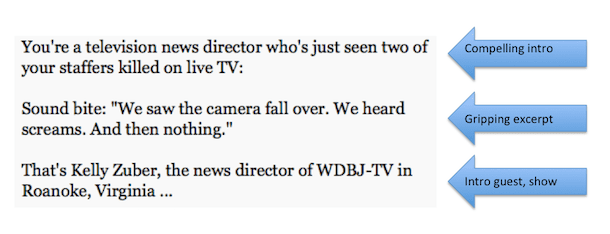
Here’s a great way to craft a compelling intro for a typical podcast interview:

1. A one- or two-sentence preview, beginning with the most compelling words you can muster, leading into …
2. A short (20-30-second) excerpt from your guest or guests—the most exciting, emotionally powerful cut in the whole show.
3. An ID for the guest(s), yourself, your show and your underwriter or sponsor—mixed, if you must, with theme music (which, based on Rivet360’s groundbreaking data, often will prove a tuneout; keep it short if you use it at all).

Here’s a sample (click to hear audio):image02

Here are more examples:


Tip: You can save yourself and your team production work by crafting your “live” intro (the one you read while you’re sitting with your subject), to include a brief pause where you can later insert a cut. The key is to write an intro that alludes to a question you’re sure you’ll be asking. If a stronger cut emerges, you can recut your first few opening words to match that clip and let the rest of your original recording flow from there.


Tip: Spare your listeners the waste of time that is “Thank you for joining us” or “Thanks for being here” at the opening. That just brings things to a halt. (Because we all know what comes next: “Great to be here.” Or “Thanks for having me.” And then a brief, awkward pause.) Thank your guests as profusely as you like—before and after your recorded segment. If you must thank guests—it is hard to resist—don’t wait for an answer; just move directly to your first question. Keep it moving, start to finish. 

My Hall of Fame induction speech: Cherish your friends, embrace your rivals (2008)

Wednesday, October 11, 2023

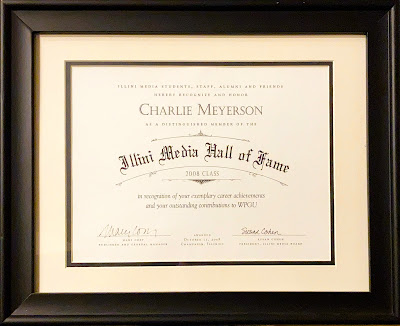
On this date in 2008, I was fortunate enough to be inducted into the Illini Media Alumni Hall of Fame. Here’s the speech I prepared for that evening. (Note: About 60 seconds before I wrapped it up—in a bit we’d worked out in advance—fellow inductee and Chicago Blackhawks announcer Gene Honda kindly interjected, as he has at so many hockey games, shouting “One minute remaining!”)

It’s hypocritical of me to stand here, because I really think Hall of Fame honors should not occur before the honoree has shuffled off this mortal coil with a clean rap sheet. On the other hand, I’d have a harder time conveying my gratitude then, so what the heck.


I want to give my thanks and my love to my wonderful family—parents, siblings, kids—and my wife, Pam, without whose amazing ability to sleep through a clock radio at 3:15 in the morning I would have almost no career at all.

And I want to share what I consider three of the most important lessons I’ve learned in the 35 years since I first cracked open a mic at WPGU’s Dorm Broadcasting System.

NUMBER ONE: Teach when you can, share when you can. Teaching others makes us better, more responsive professionals. The very act of explaining yourself helps you become better at what you do—whatever it is. And the karma comes back, in rewarding and surprising ways.

NUMBER TWO. There’s no day so bad it can’t be improved by listening to “Go All the Way” by the Raspberries. Preferably several times in a row. The repeat button on your music player was meant for this song.

NUMBER THREE. Be nice—play it straight, play it fair—with everyone, all the time. Because, if you’re lucky enough to have a career that lasts a decade or more, one day that rival could be your colleague, your neighbor, your boss—or your kid’s boss. This is a tough one, because, let’s face it, we in the media are a darned competitive bunch.

And that brings me to the story of a colleague back in my days at WPGU. He was a couple of years older and, as such, his show on WPGU used to follow my graveyard shift radio show. We had an on-air rivalry. I would insult him or play a derogatory song to introduce his show. But he taught me the hard way not to poke a stick at the guy who controls the microphone—or at least, who takes control of it after you do. One time, he proceeded to take the controls only to dedicate to me Loudon Wainwright’s classic song “Dead Skunk in the Middle of the Road.”

Now, it would have been easy for this kind of thing to get out of hand. I’ve seen it happen time and again in this profession. And, clearly, I gotta say, that memory did stick with me. So, of all the people I met during my years on campus, you might not have guessed that Tom Thomas would have become so close a friend years later. And I surely wouldn’t have guessed back then that Tom, bless him, would pass away all too soon this year while working on Illini Media matters, including—as I later came to find out—my nomination to this great, great honor.

And so, I want to thank him publicly—and say to you all: Life is too short for petty competition and emotional rivalries.

Cherish your friends, embrace your rivals. Make them a part of your life, and you’ll be glad you did.

Thank you all.

From dorm broadcasting to the digital frontier: A journalist’s journey

Thursday, August 24, 2023
I can trace the origin of my broadcasting career back to Aug. 24, 1973—early in my first year at the University of Illinois at Urbana-Champaign, when a tradition known as Quad Day gave campus student organizations a chance to introduce themselves.

In particular, I got to know student radio station WPGU—a story I shared in some detail with a speech to the University of Illinois Library team on the occasion of Homecoming weekend, Oct. 14, 2022.

To mark the 50th anniversary of that life-changing encounter, here’s video and a rough transcript of those remarks.

Stan Lee: A life in review

Saturday, June 17, 2023


‘He has a heroic moment when he invents Spider-Man.’ Variety’s Owen Gleiberman reviews a new Disney+ documentary about the late Marvel Comics icon Stan Lee
… a movie that Looper’s Reuben Baron says skips “many stranger and sadder chapters” in Lee’s life.
Not a Disney+ subscriber? You’re in luck, because …

I got a lot of the story straight from Lee himself over the decades, and you can revisit my encounters with him in 1975, 1976, 1998, 2017 … and a postmortem with two of his biographers in 2021.

Bonus, from 1997, on the occasion of Lee’s 75th birthday. Ten things I learned from Marvel Comics written by Stan Lee.

If you enjoyed this, check out my other archival work on the comics

How best to open a podcast

Monday, June 12, 2023
I haven’t posted much here lately about my work with the talented team I helped assemble a decade ago at Rivet (now formally known as Rivet360)—mostly in secret at the beginning.

That’s partly because, as I’ve shifted focus since 2017 to my award-winning Chicago Public Square email news briefing (subscribe free!), I’ve eased into a role as Rivet’s Vice President of Editorial and Development—or, as I call myself, Nagger-in-Chief.

And it’s partly because the company’s shifted its focus from journalism to become an innovative podcast consultancy—producing audio for others as well as shows of its own.

One of those shows,
PodWell—a guide to becoming better podcasters—is hosted by my friend and colleague Terri Lydon, who was kind enough to share the mic with me in her June 6 edition (recorded May 3, 2023, when I was just getting over a cold or something else that really wasn’t COVID-19).

That gave me nine minutes or so to nag on one of my favorite topics:
How best to open a podcast.

If you like this, check out more of my podcast guidance on Rivet’s website and elsewhere on this blog.

And hear more of my conversations with thought-leaders through the years on
this website, in Apple Music, on Pandora or Spotify, via your favorite podcast player and at Chicago Public Square.

(Meyerson headshot: Steve Ewert.)